
by CDoFP | Sep 25, 2026 | Uncategorized
By Mari-Len De Guzman
When Dr. Alex Bartel first hung his sign in Chilliwack in 1977, general practice meant house calls, hospital rounds, and knowing every doctor in town by name. Half a century later, the local medical landscape looks vastly different, but Bartel’s core belief has not changed: good medicine is about people and community.
Today, the good doctor is not quite retired but has stepped back from full-time family practice. Instead, his schedule now consists of office locums, hospital shifts and community clinic work.

Dr. Alex Bartel celebrates 50 years in family medicine.
September 2026 marks 50 years in medicine for Bartel. While his days look a little different now, remaining active in clinical care, albeit at a scaled-back pace, is what keeps him grounded. He says maintaining connections with his peers is key to transitioning smoothly into retirement.
“I’m still doing some hospital work primarily because it’s connecting me to my medical community, and I think we all need community. We all need some support,” Bartel says.
His locum work also provides a similar type of fulfillment. Between covering private practice panels, picking up hospital duties, and working shifts at the non-profit Ruth and Naomi Clinic, Bartel is happy to step in wherever there is a need.
For him, locuming is not about maintaining a heavy patient load but about being a reliable set of hands for peers who need a break, and offering a reassuring presence to patients navigating their health journeys.
“I’m not doing this for income now; it’s more like, ‘Who can I help?’ It’s more about helping, it’s about being connected, it’s about community,” Bartel says.
Old-school values in modern practice
Over his five decades in Chilliwack, Bartel’s impact and leadership extended beyond his clinic walls. Throughout his career, he has taken on leadership roles that helped shape the local health-care dynamic. He served as chief of staff at Chilliwack General Hospital, managed physician credentialing for Fraser Health, and served as medical director for care facilities including Valley Haven, Cascade and Waverly.
Practicing in the same city for the last 50 years has given Bartel front row seats through five decades of evolution in family practice.
Reflecting on his early years as a doctor in Chilliwack, he recalls just how broad general practice used to be — when hospital rounds were part of the daily routine and after-hours house calls were the norm.
“When you go into somebody’s house, you see how they live. You see their family, you see what’s on the walls, you see the environment. You learn things about a person in five minutes in their home that you would never learn sitting across a desk in an office,” Bartel says.
Health care has changed dramatically since 1977, he notes, witnessing primary care shift from solo practices with heavy hospital involvement, toward specialized practices, walk-in clinics and modern team-based practices.
While the delivery of care looks much different today, Bartel emphasizes the core of the profession hasn’t changed. For him, family medicine still comes down to simple, timeless principles: listening, being honest, and building genuine connections with patients.
“I hope that with every interaction you have with a patient, they feel at least you’re in their corner,” Bartel advises new physicians. He adds patients should be able to leave their family doctor feeling they have been heard and that their “story” is validated.
“I’m very much into supporting people on their journey,” he says.
Supporting that journey also requires honesty and humility.
In this era of information overload, patients would sometimes go to their family doctor having already Googled their symptoms or conditions. Rather than feel challenged when patients arrive with their own research, Bartel views it as an opportunity for collaboration.“We used to think we had to fix everything or tell people what to do.
Now it’s much more about coming alongside people,” he notes. “If patients come in and they’ve looked up stuff on the internet, and they come in with a diagnosis, I don’t feel threatened by that. I’d say, ‘Great, let’s look at that together.’”
“I often tell young doctors, ‘You don’t have to know everything.’ It’s okay to say to a patient, ‘I don’t know what’s going on, but let me figure it out with you.’ That takes a load off your shoulders, and patients actually appreciate the honesty.”
Rebuilding connections
Beyond patient care, Bartel emphasizes the value of peer connection. Decades in medical practice has taught him that isolation can be a quick path to physician burnout.
“In the old days, you knew all the doctors in town… You saw them in the hallway at the hospital, you sat in the doctors’ lounge and had a cup of coffee and talked about cases or just chatted. You knew what was going on in each other’s lives,” he recalls.
Today, with many physicians working exclusively in private clinics or specialized streams, that previously built-in daily contact is no longer the norm. To help fill that gap, Bartel has been actively revitalizing the Chilliwack Medical Society, the local association for medical doctors in Chilliwack.
The society is not a new organization. In fact, this Chilliwack “doctors’ group” predates Fraser Health and the Chilliwack Division of Family Practice, Bartel notes. While it had gone dormant through the years, Bartel believes the Chilliwack Medical Society has an important role to play, particularly in strengthening social and professional peer connections.
“Chilliwack has the advantage in that we — the GPs and the specialists — have always got along well from way back, and we just kept nurturing that sense of community,” Bartel says.
The goal, at the very least, is to be a place where physicians can get together regularly for food, coffee, conversations and everything in-between. “It doesn’t matter whether you’re in practice or retired or semi-retired or doing locums. It’s a place to stay connected,” he says.
The society can also serve as a tool for recruitment, Bartel notes. With a supportive medical society for doctors to find a fulfilling medical career, Chilliwack can be a highly attractive destination for new physicians, he adds.
Bartel recalls an interaction with a surgeon years ago who had a high-stress moment in the operating room.
“I said to him, ‘Around here, you never have to have a crisis all by yourself. There are lots of people around who’ll step in any time to support you.’ We’re all in this together.”

by CDoFP | Aug 26, 2026 | Uncategorized
Meet Dr. Kelsey Summerhill, first resident to serve on Chilliwack Division board
By Mari-Len De Guzman
When the Chilliwack Division of Family Practice opened a seat for a resident family doctor to join its board of directors, Dr. Kelsey Summerhill knew it was an opportunity she had to take.
Now in her second year as a Chilliwack Division board member, Summerhill has provided a unique perspective to the governance team and serves as a crucial voice in shaping the direction of primary care in the community.
“We are sort of caught in this in-between, where we’re not med students anymore but we’re not practicing physicians yet,” says Summerhill. “Our input as residents can be really helpful because we’re often in a unique situation where we’re seeing things from a different perspective.”
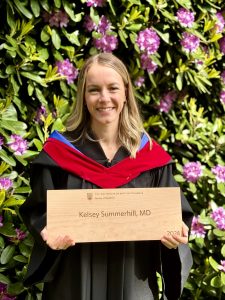
Dr. Kelsey Summerhill
An important aspect of her role on the board is educating her peers about the Division’s work and how it can impact the residents’ journey to family practice.
“Providing just a little bit of education even bridges that gap between the residents and the Division,” Summerhill adds.
That bridge-building has already translated into tangible results. With insight from Summerhill, the Division has expanded access to educational ventures and professional development initiatives that were historically reserved only for practicing family physicians and nurse practitioners.
Equally critical is her contribution to physician recruitment and retention. Bringing her early-career insights to board discussions, Summerhill helps shape strategies that make Chilliwack a more welcoming, supportive environment for visiting residents and specialty trainees.
“A big part of the Division’s role is recruitment and looking at getting people to Chilliwack to stay and work,” Summerhill notes. “I’ve been able to provide perspective on how they can make the community more appealing to residents training here now, as well as visiting residents, so we can better support them and the broader community.”
Beyond advocating for her peers, serving on the board has given Summerhill a front-row seat to the dynamics of the local and provincial health-care systems.
Navigating complex funding streams from various levels of government, for example, has provided insights on how community health decisions move from policy to practice.
“It’s been a huge learning curve,” says Summerhill. “I’ve learned a lot about where funding comes from and all the parameters that come with it. I have a much better perspective on what things can be done by the Division versus the health authority, and everyone’s role in our health-care system.”
This high-level understanding not only helps her guide current residents toward local and regional resources but also equips her to be a more effective physician-leader as she transitions from residency to full-time practice.
For Chilliwack Division, the decision to bring a resident onto the board was a strategic move to ensure the governance body reflects the makeup of the local medical community. It was also a deliberate step toward building early connections with physicians before they transition to full-time practice.
“Residents bring an invaluable, fresh perspective to the table. They see our local system with fresh eyes and represent the future of family medicine in our community,” says Daphne McRae, executive director of the Chilliwack Division of Family Practice.
“Kelsey’s insights have been essential in helping us understand how the Division can better support learners, ensuring our programs and recruitment efforts align with what new-to-practice physicians actually need.”
As the first resident to ever sit on Chilliwack Division’s board, Summerhill has set a compelling precedent that ensures the governance body truly reflects the community it serves.

by CDoFP | Aug 24, 2026 | Uncategorized
Chilliwack doc’s succession plan turns into success story for pharmacist collaboration
By Mari-Len De Guzman

Dr. Cameron Ross
What began as a succession planning project for Chilliwack family physician Dr. Cameron Ross has turned into a success story for patient-centred, team-based care — and a framework for ongoing collaboration between primary care providers and clinical pharmacists.
In anticipation of his pending retirement, Ross wanted to ensure a seamless transition for his patients as they are transferred to a new family doctor. As part of this effort, and with support from the FPSC Practice Support Program, Ross undertook a systematic medication review for a selected number of his patients who are on five or more medications.
“I was handing over my practice, and I was thinking of all the things that would make that transition better for my patients and for the new doctor,” Ross said. “One of the challenges is sometimes our medication lists are not accurate… so the prompt was to try to improve the continuity of care for all involved during the transition.”
Ross saw an opportunity to leverage the services of the Chilliwack Primary Care Network’s (PCN) clinical pharmacist Tamer Eid to help implement the project as a collaborator.
To start the pilot, Ross used the EMR dashboard to identify a cohort of 69 patients meeting the polypharmacy threshold. He then carefully triaged the list based on his deep knowledge of his panel. Patients with complex behavioral or mental health factors were kept under his direct review, while 30 to 35 patients deemed suitable for an independent clinical consultation were assigned to the clinical pharmacist.
Towards the end of the project, a key takeaway for Ross was the level of detail Eid provided in his review of the patients assigned to him. It’s a compelling proposition given the relentless time constraints family physicians face daily.
“Of particular value to me as a practitioner is the expertise applied from Tamer, and the ability to have some of this essential patient care done well by someone else, which in the long run should lead to increased provider capacity and improved patient outcomes,” Ross explained.
Time-saving teamwork

Tamer Eid
For Tamer Eid, the project highlighted how PCN clinical pharmacists can help alleviate the daily time crunch for family physicians, while enhancing patient-centred care.
For one, having full access to patient charts, lab results, specialist consults, and history within the clinic’s EMR allowed Eid to tailor his medication reviews to specific patients’ unique clinical profiles.
Ross recognized the value the clinical pharmacist has brought to the process in terms of time savings and the quality of patient review.
“He goes through all the charts and looks at all the consult notes and everything… he’s doing that heavy lifting, so I don’t have to go through years of notes,” Ross explained.
In addition to time efficiency outcomes, the impact on patient care was immediately evident. Eid’s deeper consultations with the patients provided space and time for them to ask questions and have a better understanding of their medication regimens.
“When you explain to the patient why they are taking this medication, what the goals are, in an easy-to-understand way, it changes their perspective completely,” Eid noted. “They feel heard, they feel listened to (and) that builds a huge amount of trust.”
Ross also noted that patient feedback had been generally positive, and they particularly appreciated the time Eid spent with them to go over their prescriptions.
“They found it very helpful to have someone sit down with them and go through their medications in detail,” Ross noted.
It also helped ease some of the patients’ anxiety about transitioning to a new family doctor after Ross’s retirement. “It gave them reassurance knowing that their medication list was being thoroughly cleaned up and organized as part of this transition.”
Eid said one of his takeaways from the project was the affirmation of the PCN clinical pharmacist’s role as a preliminary screen for complex medication profiles. Instead of the physician spending a significant amount of time reviewing each patient’s medication history, Eid was able to perform this exhaustive background work and summarize his findings into a concise report for Ross.
This pre-screening meant Ross could review Eid’s clinical findings and decide on treatment adjustments in minutes, without needing to manually go through years of medical records.
“When Tamer reviewed it, there was a very rigorous analysis,” Ross noted. “So my total time, aside from the time with the patient, would be as quick as three minutes and as long as five or 10 minutes to come up with very similar outcomes.”
Scaling for impact
As the project concluded, Ross and Eid both see the value of expanding this collaboration to other primary care practices across Chilliwack.
For Ross, the initiative provided a proven framework for physician succession planning, showing how PCN clinical pharmacists can help stabilize complex patient panels during practice transitions. He said he is recommending the pilot project be expanded and encouraged his colleagues at Crossroads Family Practice to consider implementing it and exploring a collaboration with the PCN clinical pharmacist.
For Eid, the pilot’s success highlights a broader opportunity to support more family physicians across the community. With the workflow framework established, he hopes more primary care providers in Chilliwack will leverage PCN clinical pharmacists as an allied health team member for complex medication management.
“I really hope that other physicians in Chilliwack see the value in this and feel comfortable reaching out,” Eid shared, emphasizing his eagerness to collaborate with more local clinics.
“My goal is to be a resource for them — to take that heavy medication review workload off their plates so they can focus on direct patient care.”

by CDoFP | Aug 7, 2026 | Uncategorized
By Mari-Len De Guzman
Finding culturally safe, holistic support for Indigenous patients can often feel like a missing piece in daily primary care practice. The Chilliwack Division of Family Practice helps facilitate this connection through its traditional wellness program.
Muriel Victor, the Division’s traditional wellness mentor, believes that blending traditional healing modalities — such as plant-based remedies and narrative sharing — with modern medicine can bridge the gap in Indigenous patient wellness.
“I call it the best of both worlds,” says Victor, a certified charter herbalist and Indigenous educator. “I’d like our Indigenous population to get the best of both worlds if that’s what they choose.”
As traditional wellness mentor, Victor serves as a resource for primary care providers and clinicians in Chilliwack, Hope, Agassiz, and surrounding communities, to help ensure Indigenous patients receive care that honours both their clinical needs and their cultural identity.
Helping providers understand how to leverage and collaborate with her role is an important part of Victor’s work, and so is educating the local Indigenous communities.
“People don’t often know this option exists, which is why I do a lot of engagement. I go and talk to a lot of people and let them know where I’m located and what I can do,” she says.
Sacred space

Indigenous sacred space inside Chilliwack Urgent and Primary Care Centre
Victor’s Indigenous sacred space is located inside the Chilliwack Urgent and Primary Care Centre on Evans Road.
While a good amount of her work involves helping her clients understand and access traditional healing and plant-based remedies, Victor says every client that comes through her doors has unique needs that go beyond just herbal medicine.
“I do whatever the Indigenous person needs to help them get to wellness or take more steps towards wellness — whatever that looks like — and it’s different for every person,” she says.
Sometimes, they might just need a conversation, talk about what they’re feeling or share stories. Other times, they can just be sitting quietly, until they are ready to talk.
Victor works one-on-one with clients to build a tailored individual wellness plan — an approach that came out of her own healing journey that began years ago.
“I had some pretty complex medication, along with stuff for my mental health — anxiety, depression — sleeping pills, and a whole bunch of things,” Victor recalls.
She then worked closely with her own physician to safely taper off heavy prescription medications while incorporating traditional plant remedies. That experience taught her the power of blending Western clinical oversight with traditional modalities, a balance she now applies to her practice at the Division.
While clients would often ask for general advice on herbal remedies, Victor avoids blanket prescriptions.
“There are so many factors,” Victor explains. “I can’t just say, ‘Take it for three weeks, two times a day,’ when I don’t know them, their age, or their prescription medications.”
Through an individual wellness plan, she takes time to understand each patient’s full health picture. Because herbal remedies can interact with conventional treatments, Victor occasionally collaborates with clinicians and providers to review prescription lists — ensuring that traditional options, like hawthorn or calming teas, complement rather than conflict with a patient’s clinical care.
Walk and harvest

Victor takes a group through a walking journey that teaches participants the healing and wellness benefits of some plants that abundantly grow in the wild.
A staple in Victor’s traditional wellness services is the regular Plant Walk and Harvest activities that she leads several times a year.
Hosted by Cristal Biela, community health specialist with Fraser Health, at her property in Chilliwack, event participants are taken on a foraging journey where Victor introduces them to some of the natural healing and wellness properties of the different wild plants that grow across the Fraser Valley.
These activities not only teach participants how to identify medicinally beneficial plants, it also educates them about food sovereignty, tree knowledge and promoting environmental diversity and sustainability.
Initially intended for primary care providers to help increase their knowledge on Indigenous healing methods, the Plant Walk and Harvest events are now open to the public, Victor says.
Complementing primary care
For primary care and other health and social services providers in Chilliwack and surrounding areas, connecting a patient or client with Victor is designed to be straightforward and low-barrier.
Referrals can come directly from primary care clinics, local hospitals or community organizations. Patients can also self-refer, connect through community events, or simply walk into her space at the UPCC.
Victor notes that initiating this connection in a primary care visit can be as simple as asking a gentle, open-ended question during routine screening.
“If a patient identifies as Indigenous, (providers) can simply ask if the patient would like to connect with a traditional wellness mentor or cultural advisor,” Victor says. “Sometimes just knowing that option exists opens up a whole new door for them.”
Victor also offers to attend clinical appointments alongside clients who feel anxious or hesitant talking to health-care providers, serving as a supportive, culturally safe bridge to ensure the patient feels heard.
Integrating traditional wellness into primary care is not about replacing Western medicine — it’s about providing Indigenous patients with wrap-around support that builds trust and fosters long-term health.

by CDoFP | Aug 3, 2026 | Uncategorized
Division leadership roles offer opportunities to shape local health care
By Mari-Len De Guzman
The Chilliwack Division of Family Practice believes in empowering community physicians and nurse practitioners to help shape the future of health care in Chilliwack, Agassiz and Hope. One way the Division is delivering this mission is through leadership opportunities that allow frontline clinicians to spearhead innovative programs, improve system efficiencies, and mentor their peers.
Meet two current physician leaders who are carving their path in innovative leadership, bridging systemic gaps and driving health-system improvements.
Driving innovation in dementia care

Dr. Abimbola Dada
As the project lead physician for the Dementia Roadmap initiative, Dr. Abimbola Dada has taken the helm of a transformative, dual-track program across long-term-care facilities in the community.
Launched to reduce the hidden trauma of preventable emergency room transfers for dementia patients, Dada’s leadership has focused on empowering both frontline staff and educating patient families.
Under her guidance, the project integrated standardized clinical toolkits directly into point-of-care workflows. The program’s impact is clear: frontline staff reported a 58 per cent increase in confidence in clinical decision-making, shifting care from reactive hospital transfers to proactive, resident-centered care.
“We know that there is no cure for dementia and our focus, basically, is end-of-life comfort care,” Dada says. “In the end, the benefits (of hospital transfer) do not outweigh the risks for dementia patients.”
Dada is driving the project’s sustainability by establishing internal facility “champions” to maintain peer-to-peer mentorship and training.
Building bridges

Dr. Perry Tompkins
In acute care, Dr. Perry Tompkins has stepped into a vital leadership role as the lead physician for Chilliwack’s Community Family Physicians In-patient Care program. Aimed at bridging communication and coordination gaps between community and hospital patient care, Tompkins advocates for family doctors who balance responsibilities in both environments.
Tompkins’ leadership ensures family doctors have a seat at the table alongside hospital specialists, giving voice to family physicians who, like him, keep one foot in both worlds to ensure their patients don’t get lost in the transition.
His leadership helps preserve continuity of care, which reduces redundant hospital testing, improves systemic efficiency, and provides patients with a smoother hospital journey.
“At the end of the day, when you get good results and the patient feels like they’ve been looked after, you get a sense of satisfaction from that.”
Shaping the future of health care
Through these leadership roles, Dada and Tompkins are stepping up to help address enduring health-care challenges.
These physicians are only two examples of how Division members are actively building and shaping a more sustainable and resilient health-care system, with leadership support from the Division.
Are you a family physician or nurse practitioner in Chilliwack, Hope and Agassiz who’s interested in taking on leadership roles in our community? Contact Divya Reddy at [email protected] to learn how.




Recent Comments